Volvo EX30 Cross Country Part 2: Mexico Real-World Range, Real-World Roads
Part 2: Mexico Real-World Range, Real-World Roads
The move from winter testing in Montebello to Mexico City changes the evaluation completely. Not because of performance. Because of the environment. High altitude. Broken pavement. Endless speed bumps. Dense traffic. This is where daily usability shows both good and negative parts very quickly.

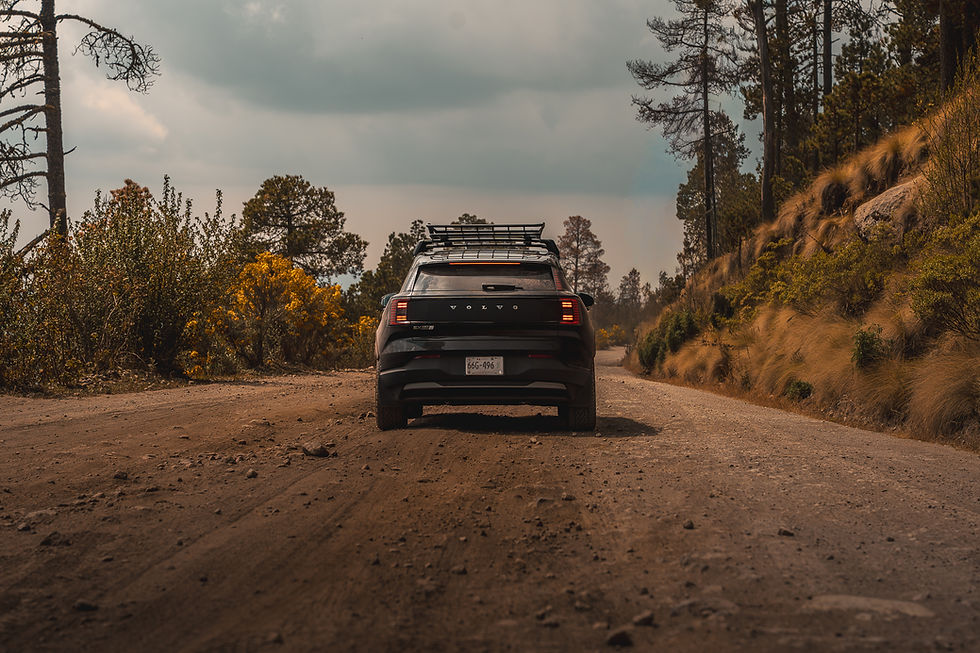
The Volvo EX30 Cross Country handles this shift well. Even at over 2,200 metres, there is no drop in performance. Electric motors do not lose power with altitude like ICE vehicles. What changes instead is how you manage energy over elevation. Using Mexico City as a baseline, we then pushed even higher. Our goal was simple: find altitude, drive up, come back down, and measure real consumption. The 224 km round-trip ranged in elevation from 2,200 metres to over 4,000 metres.
Volvo EX30 CC
Results were clear.
Average consumption landed at 12.7 kWh/100 km, a crucial figure. On the return leg, which was heavily downhill, regeneration played a major role; we started at 50 percent at the peak and arrived at 40 percent, resulting in roughly 5.8 kWh/100 km for the descent. Climbing was a different story at 23.2 kWh/100 km, though this remains a very reasonable feature. Anyone living at an altitude will understand this quickly. You do not need to charge to 100 percent every time. Elevation becomes part of your energy strategy. Volvo quotes a 365 km range (NRCAN), while the regular EX30 is rated at 420 km. This Cross Country model is equipped with all-terrain tires and a roof rack. Both increase drag and rolling resistance. Even with that, the vehicle showed 513 km at 100 percent after the drive cycle. The real-world average settled at 17.9 kWh/100 km. These results surpass official numbers, suggesting Volvo is conservative with its estimates.

Ride, Calibration, and Daily Use
Suspension tuning on this vehicle is not just cosmetic; it genuinely changes how the EX30 Cross Country copes with imperfect roads. Mexico City quickly exposes weak setups, as repeated speed bumps and uneven surfaces demand control rather than stiffness. Here, the vehicle absorbs impacts smoothly, offering more compliance without sacrificing body control. For families, this suspension tuning works wonders. Less fatigue, fewer groans from the back seat. Instead of kids jolting at every bump, the ride stays calm, even when the asphalt goes sideways. The minimalist interior still requires adaptation, as speed is shown on the centre screen, offset to the side, with no head-up display. While you can adjust, it does take time. In dense traffic, this layout demands more attention than a traditional cluster would require.
Software and Interface
There is progress here. Lock and unlock response with the key fob is now consistent. That was not always the case before. Over-the-air updates are doing their job. Small fixes like this improve daily ownership. Infotainment speed has improved. Inputs register faster. Menus load quicker. The issue is not speed. It is structured. Core functions still sit inside the central screen. Adjusting settings still requires taking your eyes off the road; in this environment, that is less than ideal. A heads-up display would help a lot. A single front soundbar handles the audio system. From the driver’s seat, output is acceptable, with clear sound but limited depth. Rear passengers, however, do not experience the same distribution as they would with a multi-speaker setup—a difference families on long drives will certainly notice.

Charging Reality
We were not able to test DC fast charging on this trip. Infrastructure access and app limitations remain a barrier when travelling outside Canada, and the U.S. Network compatibility, payment restrictions, and account requirements can block access even when stations are physically available. For a detailed breakdown of these limitations, refer to this piece: EV charging realities for Canadians travelling in the U.S./Mexico
Volvo EX30 CC
Family Use and Practicality
Daily usability remains strong. Compact size works in tight urban environments. Visibility is good. The raised ride height helps over speed bumps and steep entries. Rear space is usable for a small family. Entry and exit are easy. The quiet operation in EV mode stands out in early mornings and late evenings. No vibration. No noise. That changes how the vehicle fits into family routines. Cargo space remains consistent with the EX30 platform. It handles groceries, school bags, and short-trip gear without issue. For longer trips, packing requires planning.
Continuity from Part 1
In Montebello, the EX30 Cross Country tackled ice and snow with ease. Now, Mexico delivers the opposite extreme. Hot, high, rough, and it shrugs, showing the same confidence. Different worlds, familiar outcome. Solid, steady, efficient.

Verdict
The EX30 Cross Country confirms its positioning. This is not a styling exercise. The hardware changes matter. Suspension tuning works. Real-world efficiency exceeds expectations, even with added drag from accessories. The limitations remain clear. Screen dependency. No head-up display. Average audio performance. But the core is strong. It adapts to terrain. It manages energy intelligently. It fits into daily family life without friction. That balance is what defines it.


Comments