Polestar 3 vs BMW iX: Two Visions of the Premium Electric SUV
- Marc Gonzalez

- Apr 20
- 6 min read
Polestar 3 vs BMW iX: Two Visions of the Premium Electric SUV
Today's matchup brings two premium midsize electric SUVs face-to-face in an increasingly crowded segment: the Polestar 3 and the BMW iX. Polestar, a relative newcomer, squares off against BMW, which has been building strong momentum in the EV space with standout models like the i4 and i5. With that in mind, let's take a closer look at how they compare. The BMW iX carries a starting price of $109,600 and is produced at BMW's Dingolfing plant in Germany, while the Polestar 3 starts at around $100,000 and is manufactured in Chengdu, China.
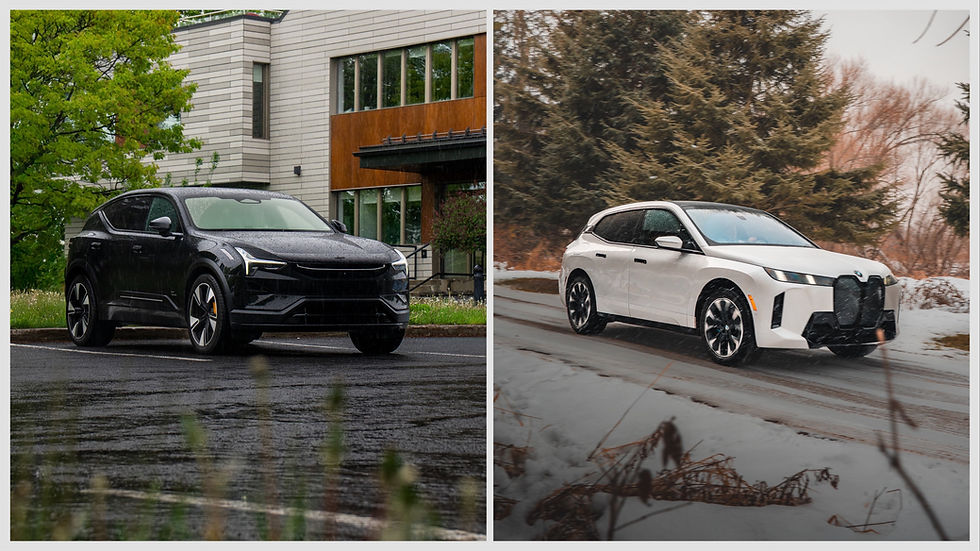
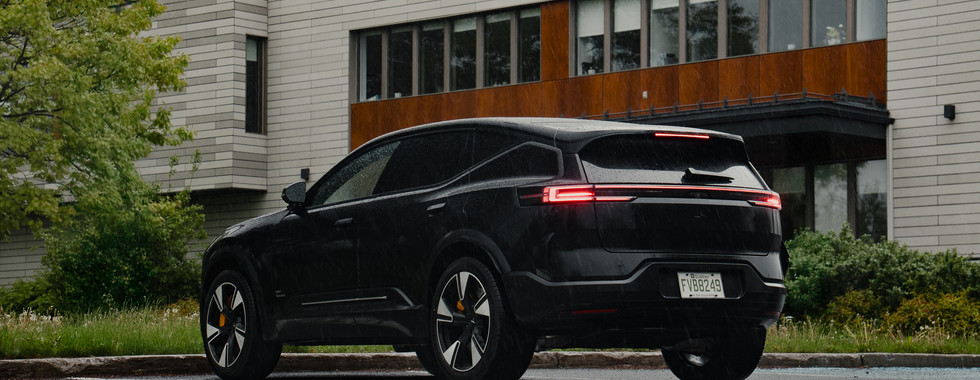
The BMW iX and Polestar 3 take two completely different approaches to design, and putting them side by side really highlights that contrast. It's bold German experimentation versus restrained Scandinavian minimalism. BMW goes all-in on futuristic, concept-car energy. The iX is impossible to miss, thanks to that massive, closed-off kidney grille, sculpted body panels, and proportions that feel more like a design exhibit than a traditional SUV. It feels polarizing: wide, tall, and visually heavy. Add in illuminated grille details, sharp body lines, and glossy black panels, and stands out amongst the rest of the lineup, but not in a good way. The Polestar 3 tells a different story. It's cleaner, sleeker, and more disciplined. Low and wide with a coupe-like roofline, it uses subtle surfacing to reduce visual bulk. The "Thor's Hammer" headlights, full-width rear light bar, and integrated aero touches, like the front wing and rear spoiler, give it a sleek, almost architectural presence. If the iX is about standing out in traffic, the Polestar 3 is about timeless design; the point goes to the Polestar 3.


Hop inside the BMW iX, and the numbers back up the spacious, lounge-like vibe. The interior room is quite impressive, and front and rear occupants have plenty of legroom and headroom. Cargo space is a huge win, too, with 35.5 cubic feet (1,005 litres) behind the rear seats and a cavernous 77.9 cubic feet (2,206 litres) with them folded down. Dominating the dashboard is BMW's curved display: a 12.3-inch digital gauge cluster paired with a 14.9-inch touchscreen running the latest iDrive system. It comes with wireless Apple CarPlay and Android Auto, and the real kicker is the iDrive controller. Having that physical dial makes navigating the system a breeze, especially compared to setups where everything is buried in a screen menu. The layout feels logical and well thought out, even with all the tech packed in. The premium Harman Kardon sound system is always a nice plus. For families, the vehicle is equipped with ISOFIX/LATCH points, rear anchors, multiple USB-C ports, and an optional four-zone climate control. Everything here is built for comfort and ease; the materials feel soft and luxurious throughout the cabin.




Step into the Polestar 3 and the vibe shifts. While the cabin is still roomy, it feels more structured and less airy than the iX. The centrepiece is the 14.5-inch vertical touchscreen, which runs Android Automotive with Google built in. It sounds ideal in theory: Google Maps, Assistant, and various apps all seamlessly integrated. But in practice, the interface often feels crowded and needlessly complicated, with essential controls hidden deep in menus and a single physical button to turn on and off the multimedia. The controls for mirror and steering adjustments are also integrated into the Android Automotive system, which still feels underbaked and prone to occasional bugs and quirks. The system even integrates the glove box release, meaning no glove box if the power goes out. On the bright side, the camera system is great; it also includes wireless Apple CarPlay and, funnily enough, Android Auto was released later, even though the system is already Google-based. Shoutout to the Bowers & Wilkins sound system, which worked wonders again. The difference is in the execution: the Polestar's interface appears sleek but can be frustratingly confusing in daily use. The Polestar 3 still checks the family boxes with ISOFIX points, rear anchors, and three-zone climate control. The cabin is quite spacious for four adults, but cargo space drops to 17.1 cubic feet (484 litres) behind the rear seats and expands to around 50 cubic feet (1,411 litres) with them folded.

On paper, both the BMW iX xDrive60 and the Polestar 3 bring serious performance, but their personalities come through in the details. On one hand, the BMW iX xDrive60 is backed by a 113.4 kWh usable battery and delivers about 536 hp and 564 lb-ft of torque, launching from 0–100 km/h in roughly 4.5 seconds. The power delivery is smooth and relentless rather than aggressive, building speed effortlessly. Its standout feature is its impressive range: up to 586 km, placing it among the longest-range EV SUVs in its class. During our testing, we got snowy and icy conditions, and the iX was still capable of doing 411 km of range at about minus 5 degrees Celsius. Charging peaks at around 195 kW DC, with a typical 10–80% top-up in about 35 minutes, making it solid for road trips.

On the other hand, the Polestar 3 uses a 111 kWh battery pack and produces 489 hp and 620 lb-ft of torque, giving it a slightly more torque-heavy feel off the line. Acceleration is a touch slower on paper at about 5.0 seconds to 100 km/h (closer to 4.7 seconds with the Performance Pack). EV range converts to roughly 506 km, which is still shorter than its German competitor. We observed a range of about 443 km during our time with the vehicle at temperatures of about 20 degrees Celsius. Where it gains ground is charging: with a peak of 250 kW DC, it can go from 10–80% in about 30 minutes, giving it a slight edge when you're covering long distances.


The BMW iX xDrive60 leans heavily into refinement, but there's more to it than just "comfortable." What stands out is how well it controls its size and weight with genuine composure. It combines ample power with surprisingly agile handling and a remarkably smooth ride, while virtually eliminating road and wind noise from the cabin. Spend more time behind the wheel, and the engineering beneath becomes increasingly apparent. With adaptive air suspension and optional rear-wheel steering, the iX feels much more agile than its size suggests; it's significantly easier to maneuver on the road than a vehicle of this size has any right to be. The ride quality is a standout feature: it glides over rough pavement, absorbing imperfections without ever feeling detached. Push it harder, and it remains composed. There's a strong grip, well-managed body roll, and precise throttle response, though it never truly invites spirited driving. Instead, it shines as a long-distance cruiser, to the point where speed accumulates almost unnoticed.


The Polestar 3, by contrast, is more focused on engagement, and that becomes evident in nearly every facet of its driving character. It offers a more dynamic driving experience, which is uncommon in this class of premium electric SUVs, largely due to its hardware. With a near 50:50 weight distribution, adaptive dampers, and a torque-vectoring rear axle, the Polestar 3 is more eager to change direction than expected. It rotates naturally through corners, with minimal body roll and a chassis that feels playful rather than merely capable. What truly distinguishes it is the sense of balance. Pushing the 3 harder, and it remains predictable and composed, inspiring confidence. Steering is light but direct, and while it may not be rich with feedback, it responds swiftly and accurately. The trade-off? It doesn't isolate like the BMW. You feel more of the road and more of the chassis working beneath you; it can be considered a minor drawback.

The Polestar 3 and the BMW iX are taking two different approaches to the midsize premium electric game. Polestar achieved a balance of class and refinement without feeling like a couch on wheels, becoming a genuine player in the segment, while BMW took a bold approach on the outside and a minimalist one on the inside. Ultimately, the difference becomes clear: the iX is engineered to remove effort from driving, while the Polestar 3 gives some of it back. We were pleasantly surprised too; nonetheless, the BMW iX takes the highly-contested top spot in this one, mainly thanks to its superior interior.


Comments