2027 Nissan Rogue e-POWER First Drive: The Hybrid We Were Waiting For
2027 Nissan Rogue e-POWER First Drive
There were earlier Rogues I would steer people away from. Nissan had some difficult years, and my recommendations reflected that. The progress over the past two model generations has changed my opinion considerably. This new hybrid now belongs near the top of my family-SUV shopping list.
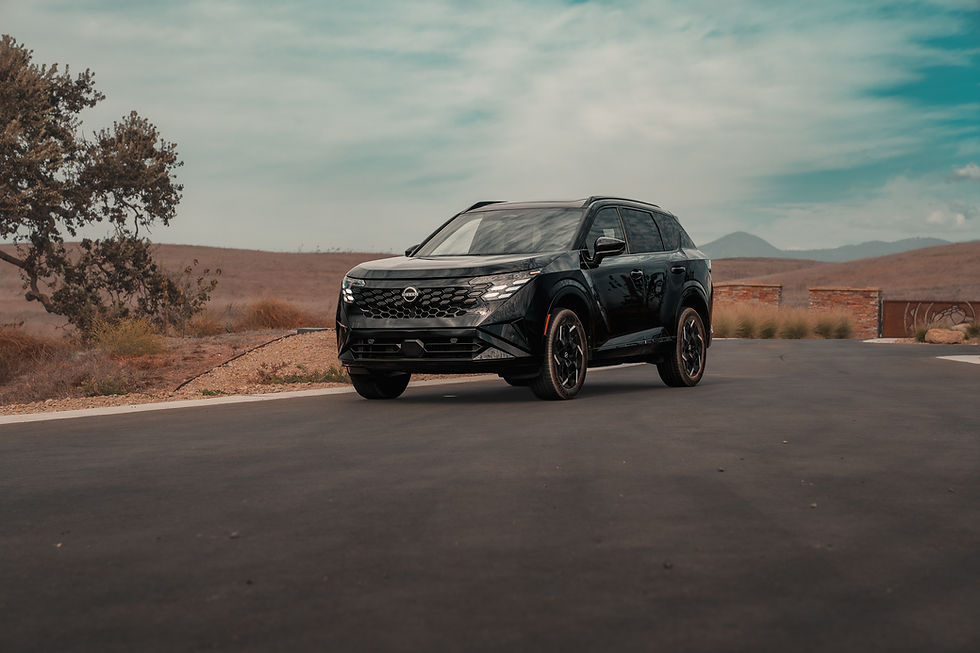
My introduction to Nissan’s e-POWER technology happened in France, behind the wheel of a Qashqai. Between Paris and Saint-Malo, its smooth power delivery made a lasting impression. I came home wishing North American families could experience something similar.
After driving the 2027 Nissan Rogue Hybrid e-POWER around Santa Barbara, California, I found plenty of what I liked in that Qashqai. The Rogue is bigger, and I liked its seats even more. It feels like a sensible evolution of the idea and a big step forward for the Rogue.

The smoothness is what sells it
The first thing I liked was simply how smoothly it drove. Pull away, ask for more speed or settle into a cruise, and it feels much like an EV. There is a straightforward reason for that. Electric motors turn the wheels. Every Rogue e-POWER comes with all-wheel drive for now, using one electric motor at the front and another at the rear. The gasoline engine drives a generator that supplies electricity to the motors and battery; it never mechanically drives the wheels. You still buy gasoline, but you get the immediate response of electric motors without a conventional transmission changing ratios.
What surprised me was how much I could ask of it before the engine needed to join in. A little more accelerator did not automatically mean the engine started. I could build speed gently and cruise with it off when the battery had enough charge. Sometimes, when it did start, I barely noticed.
2027 Nissan Rogue E-power SR
Yes, it moves
It also accelerates faster than I expected. Nissan quoted 0–60 mph in 6.4 seconds during the media presentation. The company claims that makes it the quickest in its hybrid class, ahead of the Toyota RAV4 Hybrid. I did not independently time that figure, but after driving it, the claim did not seem far-fetched.
I tried accelerating from a standstill uphill on the mountain route. The response was strong, and the engine stayed surprisingly quiet. I could hear it working, but it did not sound nearly as busy as I expected given what I was asking of it.
The steering is light. I would welcome a little more weight for winding roads, but around town and when parking, that lightness makes sense. Its job is to be an easy, comfortable family SUV, and I enjoyed it on those terms. There is also proper one-pedal driving through e-Pedal, including the ability to come to a complete stop in suitable conditions. If you already enjoy that feature in an EV, you will appreciate finding it here.

Nissan brought a RAV4. I drove that too.
Nissan supplied a new, fully equipped 2026 Toyota RAV4 Hybrid and let me drive it on the same route. Bringing a direct competitor to your own launch takes confidence. The difference was easy to hear. Even with a modest request for acceleration uphill, the Toyota’s engine became loud. It sounded as though I had asked it to move the mountain rather than to drive up it. The Rogue handled the same kind of driving with much less fuss.
That comparison helped explain why I had enjoyed the Nissan so much. Its smoothness was not just a good first impression; switching vehicles made the difference more obvious. I preferred the Rogue’s seats and cabin materials too. The RAV4’s interior felt cheaper in places, and its seats were less comfortable. Toyota’s steering was firmer, which some drivers will prefer. I would still take the Nissan after driving them back to back.

The seats were a highlight
The Rogue’s front seats are among the best I have tried in this segment. They supported me well and remained comfortable over several hours. The manually adjustable passenger seat in my SR was a miss. It is an obvious place where Nissan saved some money, and I would have liked power adjustment. Otherwise, there was very little in the cabin that bothered me.
Physical climate controls helped. I could change the temperature without having to work through a screen, which is exactly how I like it. I also liked the way the SR looked. Its styling gives the Rogue more personality, and the small Japanese references are a nice touch. The Mount Fuji detail at the rear is cute, as is the two-and-three-line motif. Most owners may never think twice about them, but I appreciate a few details to discover while photographing it.
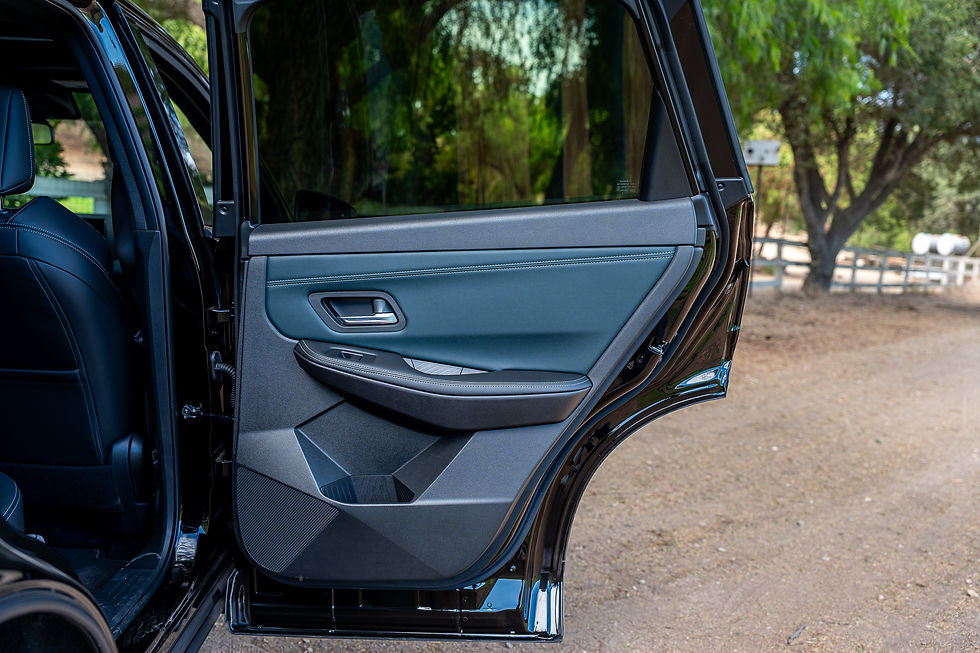
Room for family life
Those rear doors open nearly 90 degrees. For anyone reaching in to buckle a child or manoeuvre a child seat through the opening, that is useful space. I did not install my own child seats during the launch, but access looked very promising. There are 5 lower LATCH anchors across the rear bench, allowing a centre-position installation as well. That gives parents more flexibility, although fitting three seats across will still depend on the seats themselves.
I spent a bit of time in the back seats while taking photos. There is plenty of room for feet without a large centre tunnel getting in the way, and it is a comfortable place to be even as an adult. Add the big trunk, and the interior proportions almost feel like those of a raised wagon.

My fuel consumption, hills included
At the end of the photographed portion of my drive, the trip computer showed 35.6 US mpg. That works out to approximately 6.6 L/100 km over 118 km. I drove highways, mountain roads and smaller roads around Santa Barbara, stopping along the way for photos.
I also saw a much more flattering number on one stretch: 99 US mpg, or about 2.4 L/100 km, over approximately 32 km. The catch was that the first 8 km were downhill, followed by around 24 km of highway. Regenerative braking gave the battery a useful helping hand on the descent.
It was interesting to see how well the system used those conditions, but 6.6 L/100 km is the more representative result from my drive. Both readings came from the dashboard rather than a full-tank calculation.

Would I recommend it?
Yes. Especially to someone who likes the smoothness of an EV but cannot charge at home. The Rogue starts at $39,998 MSRP in Canada for the SV. The SR I drove is listed at $47,998 MSRP. The SR arrives first, with the broader range following in early 2027.
The biggest thing I still want to find out is how it behaves at −20°C. I liked the quiet engine operation in California, but heating the cabin through a Quebec winter will make different demands on the system.
For this first drive, though, there was little to complain about beyond the passenger-seat adjustment. I liked the design, loved the seats and enjoyed driving it. At the end of the day, I went to California expecting to like the Rogue. I didn’t expect to feel sorry for the RAV4 Nissan brought along.


Comments